


Your sales team is working hard, not selling
Sales productivity is collapsing: reps spend under 3 hours a day selling. Discover where rep time goes and how AI agents recover it.

There is a number that should keep every revenue leader up at night.
of a sales rep's week is spent on actual selling.
The other 72% produces zero direct revenue.
That is the percentage of a sales rep’s week spent on actual selling — calls, demos, negotiations, advancing deals. The Salesforce State of Sales report is clear on this: reps spend less than 30% of their week on selling activities. Simultaneously, 78% of sellers missed quota in 2025, up from 69% the year before.
Those two numbers aren’t a coincidence. They’re the same problem wearing two faces — and most revenue leaders treat them as separate.
Where the week actually goes
Map out a standard 40-hour week for a B2B sales rep and the picture is uncomfortable. Active selling — live calls, demos, negotiations — accounts for roughly 11 hours. The rest disappears into non-revenue work.
| Activity | % of week | Hours / week | Value generated |
|---|---|---|---|
| Live selling (calls, demos, closing) | 28% | 11.2 | Revenue-generating |
| Prospect research and call preparation | 14% | 5.6 | Enabling |
| CRM updates and data entry | 17% | 6.8 | Zero |
| Internal meetings and reporting | 15% | 6.0 | Minimal |
| Email admin and inbox management | 14% | 5.6 | Zero |
| Scheduling and coordination | 12% | 4.8 | Zero |
That is 29 hours per week producing no direct revenue. Per rep. Every week. Over the course of a year, each rep loses the equivalent of 37 selling weeks to non-selling activity. On a team of 10, you are burning 370 weeks of potential pipeline every single year — without a single poor performer on the roster.
The hidden tax nobody budgets for
Beyond time allocation, there is a data quality problem compounding the damage. Industry research consistently shows that reps spend more than a quarter of their time working with inaccurate contact data — wrong numbers, bounced email addresses, contacts who left companies months ago.
Picture it: two hours preparing for a discovery call, only to find the champion has moved on. The time is gone. So is the momentum. So is the motivation that comes from productive work.
This is not a minor inefficiency. It is the largest hidden cost in most revenue organisations — and it never appears on a P&L.
Then there are the meetings. The average rep gives up around 15% of the week to standing syncs, cross-functional updates, and pipeline reviews where CRM data is read aloud to a room that could have read it themselves. A few of those are worth the time. Most are a tax on selling capacity dressed up as oversight.
More tools made it worse
The standard response to this problem is to buy technology. Add a prospecting tool. Layer on a sequencing platform. Deploy an enrichment service. Subscribe to an intent data provider.
The instinct is right. The way it has played out is not.
The average sales rep now navigates eight different tools to close a single deal. Gartner found that 72% of sellers feel overwhelmed by the number of skills their job now requires — and that overwhelmed sellers are 45% less likely to hit quota.
Every individual tool had a defensible ROI argument. In aggregate, they created a meta-problem: reps spending meaningful portions of their day switching between systems, reconciling conflicting data across platforms, and learning interface updates that ship every quarter.
This is the tool paradox. Each tool promises to save time; eight of them together hand most of it back as cognitive load. The fix isn’t another tool. It’s fewer surfaces carrying more intelligence.
What top performers actually do differently
A small share of sellers consistently produces a large share of revenue — that much is well documented across the research. What’s striking is that the gap doesn’t track neatly with talent, product knowledge, or hours worked.
Top performers spend noticeably more of their time on active selling than the 28% average. Even a 7 to 12 percentage point difference is worth several additional selling weeks per year. Compounded across a full year, it is often the difference between hitting quota and missing it.
Three behaviours separate them. They research once and reference many times — maintaining living account briefs rather than repeating the same searches before every touchpoint. They tier their pipeline ruthlessly, spending the majority of their time on high-fit accounts showing active buying signals rather than spreading effort evenly. And they deploy AI where it actually eliminates work, not as a novelty for generating email drafts.
The critical distinction: AI used effectively as a research analyst and administrative layer — not AI as a chat interface that still requires a human to do the thinking first.
Two mornings. Same quota. Completely different outcomes.
Picture two sales reps at the same company, same product, same target number.
The difference isn’t talent — it’s system design. Rep B spent no time on manual research, no time deciding who to call, no time on dead-end accounts. Every minute of the morning went to revenue-generating work, informed by intelligence that was waiting when she logged on.
Meet your AI Virtual Team Mates
This is the gap DataChi was built to close. Our Virtual Team Mates (VTMs) are autonomous AI agents that work alongside human sellers — not instead of them. They observe deal activity and buyer signals, execute repetitive workflows, and hand back time for what humans do best: building relationships, reading rooms, navigating complexity, closing deals.
Identifies ideal-fit prospects based on your ICP and runs personalised outreach across email and LinkedIn — continuously, without being prompted. See it in the cold outreach playbook.
Logs every call, email, and meeting automatically. Enriches contact and company data. Keeps your pipeline current without a single manual entry — the same engine behind our CRM data cleanup playbook.
Ensures no lead goes cold. Operates on its own cadence, aligned to your sales methodology. No reminders needed. No leads forgotten. See the inbound follow-up playbook.
Analyses your deals, flags risk before it becomes a lost opportunity, and surfaces next-best-action recommendations grounded in data — not gut feel. Watch it rescue stalled deals in the deal revival playbook.
Every VTM learns from the human it works with. Configurable autonomy settings mean your team builds confidence at their own pace. You stay in supervision mode. Your VTMs handle execution.
The compounding math
Move a 10-person sales team from 28% selling time to 40% selling time. Here is what that means in practice.
| Annual selling capacity — 10-person team | |
|---|---|
| Active selling hours/week today (28%) | 112 hrs |
| Active selling hours/week with VTMs (40%) | 160 hrs |
| Additional selling hours per year | 2,400 hrs |
| Equivalent full-time sellers added | +4 FTEs — without a single new hire |
The revenue impact does not scale linearly. More time on the right accounts produces higher conversion rates, faster deal velocity, and stronger pipeline coverage. Conservative modelling suggests a 15 to 25% revenue lift from a 10-percentage-point improvement in selling time allocation. Bain’s Technology Report 2025 reinforces the upside: AI has the potential to roughly double the time reps spend actually selling, and to lift win rates by more than 30% for organisations that deploy it against the specific non-selling activities consuming rep time.
Built for Europe. Built by sellers.
DataChi is headquartered in Luxembourg and runs on a fully EU-sovereign architecture. No US-cloud dependency. Full GDPR and EU AI Act alignment — the details are on our trust page. Luxembourg businesses can access up to 70% funding on AI adoption through the Fit4AI and SME AI subsidy programmes.
We were not built by technologists who read about sales. We were built by revenue professionals who spent decades living the 72% problem — late nights on CRM updates, missed follow-ups, pipelines that never reflected reality, and administrative work that crowded out the conversations that actually move deals forward.
That experience is embedded in every VTM we deploy.
The leaders who move first win
Gartner forecasts that by 2028, AI agents will outnumber human sellers 10 to 1. The teams that build the operational infrastructure to leverage this now will not just be more productive — they will be structurally more competitive than organisations still compensating for low selling time by hiring more headcount.
Whether AI reshapes B2B sales isn’t really the question anymore — it already is. The real one is narrower: will your team spend the next three years grinding through that 72% by hand, or hand it to Virtual Team Mates so your best people can stay in the conversations that actually close revenue?
If your reps are spending under three hours a day on actual selling, effort isn’t the problem. The system they work inside is.
DataChi changes the system.
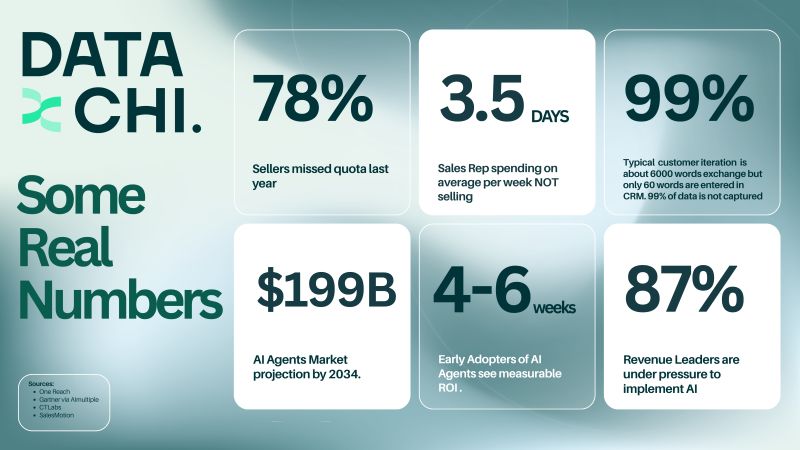
Some real numbers
of sellers missed quota last year.
the average rep spends per week not selling.
A typical customer interaction runs ~6,000 words, but only ~60 land in the CRM — 99% of the data is never captured.
projected AI agents market by 2034.
for early adopters of AI agents to see measurable ROI.
of revenue leaders are under pressure to implement AI.
Sources: One Reach · Gartner (via AIMultiple) · GTLabs · SalesMotion
Ready to recover your selling time? Book a 20-minute AI Sales Strategy Call. We will audit your current sales workflows, identify where your team is losing selling time, and show you exactly which tasks your Virtual Team Mates can take over from day one. No commitment. No pitch. Just a clear picture of what’s possible.
More from Sales
Cold outbound: the 2% reply-rate ceiling, and what actually moves past it
Why most B2B SDR teams plateau at a 2% reply rate, why volume and shallow personalisation don't fix it, and what research depth combined with signal-driven triggers actually does to the number.
DataChi Featured in Silicon Luxembourg's July 2026 Startup Radar
DataChi is featured in Silicon Luxembourg's July 2026 Startup Radar of startups to watch. Discover why it matters and how to claim a 70% refund via SME Packages.
Why every CRM cleanup project regresses within six months
RevOps lands the budget, a consultancy runs a six-week sprint, the duplicates close, reporting improves. Six months later the duplicates are back. A note on why cleanup is maintenance, not a project, and what continuous hygiene actually requires.